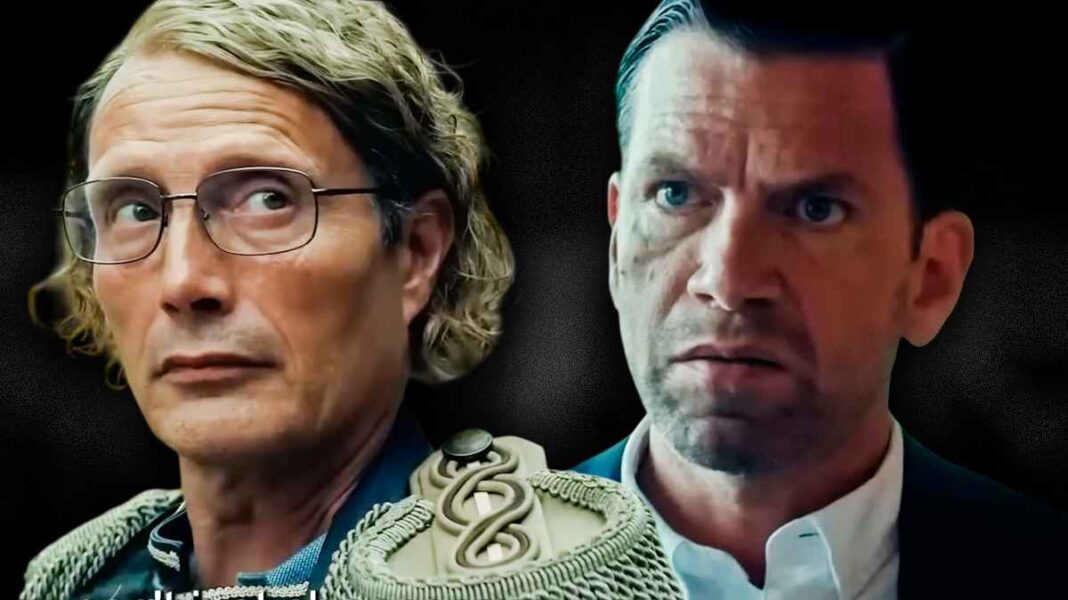
“The Last Viking” starring the impeccably-fit-for-every-role Mads Mikkelsen in its lead role of a middle-aged man with a dissociative personality disorder who thinks that he is John Lennon is a deeply delicious, absurdist comedy with its heart at the right place. It is a weirdly beautiful cocktail between a thriller and a psychological tale– but not a psychological thriller, which bends genre becoming a menacing dark comedy in its becoming. The tale starts off dead pan with the incredulity of the events consisting of reforming The Beatles through people with dissociative personality disorder, and the search for a lost twenty million dollar. However, it also juxtaposes the Viking tale of Baldur as a background hum that takes the film to a psychological direction. Let’s take a look at what the film is really about.
Spoilers Ahead
What is Baldur’s Tale?
The film starts off with an animated tale of this Viking prince named Baldur who lost his arm during an attack on their village. The king, worried that his son would be singled out, orders the cutting of the left arm of all his subjects just so that not having a left arm becomes the norm and Baldur fits in with ease. While this animated tale may seem bewildering to the rest of the plot, it runs deep in its veins of characterization. Baldur is a character that Manfred used to dress up as when he was a kid. He had a deep interest in Vikings, would play with figurines, and made a headgear of a Viking helmet that he would often wear to school believing that he is the last of the Vikings. This did not sit well with their father, and he would beat Manfred up to give up this little cos-play. While this may have been the origin of Manfred’s personality disorder, the real reason he gave up being Baldur and later in life became John Lennon is darker which we only find at the end of the film. Before we reach that end, Manfred is pretty convinced that he is John Lennon and if anyone dares to call him by his real name, he throws a suicidal feat. This happens especially when Anker, Manfred’s brother, is back from prison and insists on calling him Manfred. Soon, Anker is visited by Flemming, his former accomplice in a robbery, who now very oddly demands Anker’s share of twenty million dollars after having spent his own share. Oddly enough, Anker decides to give Flemming what he wants instead of fighting him back, and he embarks on a journey towards their parent’s cabin which has now turned into an Airbnb hosted by a couple.
Where is the Money?
Fifteen years ago, before he was arrested, Anker gave his brother the key to a safe deposit with the money asking him to bury it near their parents’ cabin It goes to show the extent of trust that Anker puts on his brother, but on the surface he is fairly dismissive of his antics unlike their sister Freya who is more tender to his needs. When Anker needs to get that money, he turns to Manfred since he is the one who buried the money. Together, the two get on the road to travel to their parents’ house to get the money back. However, Anker keeps calling Manfred by his name and not John, resulting in repeated suicide attempts. At the first one, he rolls out of the car opening the car door and ends up in a hospital. In the second one, he jumps out of the hospital window. While Anker still does not back out, he meets Lothar, a psychiatrist (who later turns out to be a patient) who claims to know other people who claim that they are the other members of The Beatles. His dream is to provide them a new reality by reforming The band. However, soon Anker refuses to take part in this and runs off with his brother on the way to the cabin.
At the cabin, his repeated attempts at asking his brother to locate the money fails. Instead, Manfred leads him to spots of memories like where they buried their dog and marked it with a skull. Anker feels that Manfred remembers everything and only pretends that he has a personality disorder. However, nothing leads Anker to the money. Meanwhile, they make friends with the Airbnb hosts Werner and Margaret. Werner has been trying to write a children’s book for the past eight years and not succeeding, and Margaret still reminisces about her modelling career that never took off. Soon enough, Lothar turns up at the cabin with the rest of The Beatles and starts planning a show. While the brothers are having quite the time at the cabin, Flemming back home holds Freya hostage.
How did Manfred Become John?
Dissociative personality disorder usually is a result of a traumatic event that splits the sense of self into multiple identities to deal with the trauma. As the story progresses, we learn about the incident that happened in the past where Manfred stopped becoming Baldur and later became John Lennon. However, before that, Freya escapes and turns up at the cabin, outwitting Flemming. Flemming follows suit and arrives at the cabin and holds Manfred captive. He cuts off his finger and asks him to drive to the location of the money. However, midway, Manfred bravely rolls out of the car driving the car with Flemming to an accident. Flemming dies with his last words being everyone in that family has a serious mental illness.
While Manfred’s condition seemed an individual issue to deal with, the end of the story reveals that Anker had a role to play in this split. As children, their father would beat up Manfred for being the odd one out in a Viking’s costume. One day, his father rolls down the staircase hurting himself badly and threatens Manfred that as soon as he gets back up on his feet, he is going to finish him. Anker, who bore a silent witness to his brother’s abuse all this time, made a decisive move. He picked up an axe and brutally murdered their father. The day it happened, Lennon got shot by Mark David Chapman; the broadcast ran on the TV as their father lay dead. While dissociation is an effect of trauma, so is repression. Anker repressed this memory thinking that he had dreamt about the entire incident. However, after Flemming’s death, Manfred leads him to dig in the spot where they had buried their father with his belongings in a suitcase. Now Anker remembers everything, and understands why Manfred became John.
Do they Find the Money At All?
This is a story that appears to find the money, but ends up getting to the origin of its characters. When that is done, Anker digs in and finds the twenty million buried right in front of the cabin. Anker tells Freya about his patricide who breaks down at first, but then makes peace with the truth. Among all the happenings, Anker also finds out that Lothar is actually another dissociative patient named Kjeld, but he successfully forms the band together with the rest. The film in fact ends with a performance of this new The Beatles, with members being Paul and George in the same body. Werner, the Airbnb host, finds the perfect plot for his children’s book, adapting Baldur’s story into a book.
In the end, “The Last Viking” is not really about the missing money, but about how people survive pain and it turns them into other, unrecognisable people. Baldur’s story explains the rationale behind protecting the child who is different, instead of making him feel like the odd one out. Perhaps, the reinvention of The Beatles in just that left hand cutting for Manfred. Becoming John Lennon is not a joke or a delusion, but it is his tool for survival when being himself was not safe. While he survived by picking up a personality that he found proximate to the event of trauma, Anker survives by forgetting what he did, and Freya survives by avoiding confrontation.
Once Anker acknowledges killing their father, the story stops running from itself. When the money is finally found, it almost feels unimportant, as what matters is the resolution of past wounds that this journey brings the siblings. Resonating that, the film ends on a gentle note where music is being made, a children’s book is being written, and old pain is turned into something more than just wounds. “The Last Viking” suggests that healing does not mean becoming “normal”, but it involves learning about the roots of the trauma and no longer being ashamed to face what it made you.